Each year, we here at Chambers Associate are fortunate enough to be invited to attend the National Association of Legal Search Consultants (NALSC) Annual Conference, which sees hundreds of legal recruiters and industry experts from across the nation gather to share market knowledge and discuss what’s keeping them up at night. And each year, we come away with a wealth of knowledge about trends in the legal recruiting industry, lateral movement best practices, and general anecdotes to impart upon our audience.
As part of our work on the Chambers Associate Career Moves hub, which explores regional legal markets, trends in lateral activity, and best practices for making a career move, we use these conversations and connections to shape practical insights for our audience. For associates considering a lateral move, or for those simply trying to understand where the market is heading, the conversations at NALSC 2026 offered a clear window into how law firms are thinking about talent, technology, and retention. Read on for our key takeaways from the conference.
1. In case you hadn’t already noticed, AI and the technology boom are reshaping BigLaw as we know it.
Predictably, artificial intelligence was a dominant theme across this year’s conference. A large portion of the conference sessions involved discussions about AI in some way, shape, or form, whether that was how to use AI to maximize job efficiency, how AI is transforming legal work, or discussions on the general appetite for AI. This should come as no surprise as AI continues to stay top of mind for many professionals, not least those tied to the legal industry.
As such, trends are beginning to emerge between how associates rate their law firm’s AI strategy and their overall job satisfaction. Data from our latest Chambers Talent Survey shows that law firms with stronger AI integration score higher across multiple satisfaction metrics than those lagging behind with AI strategy.
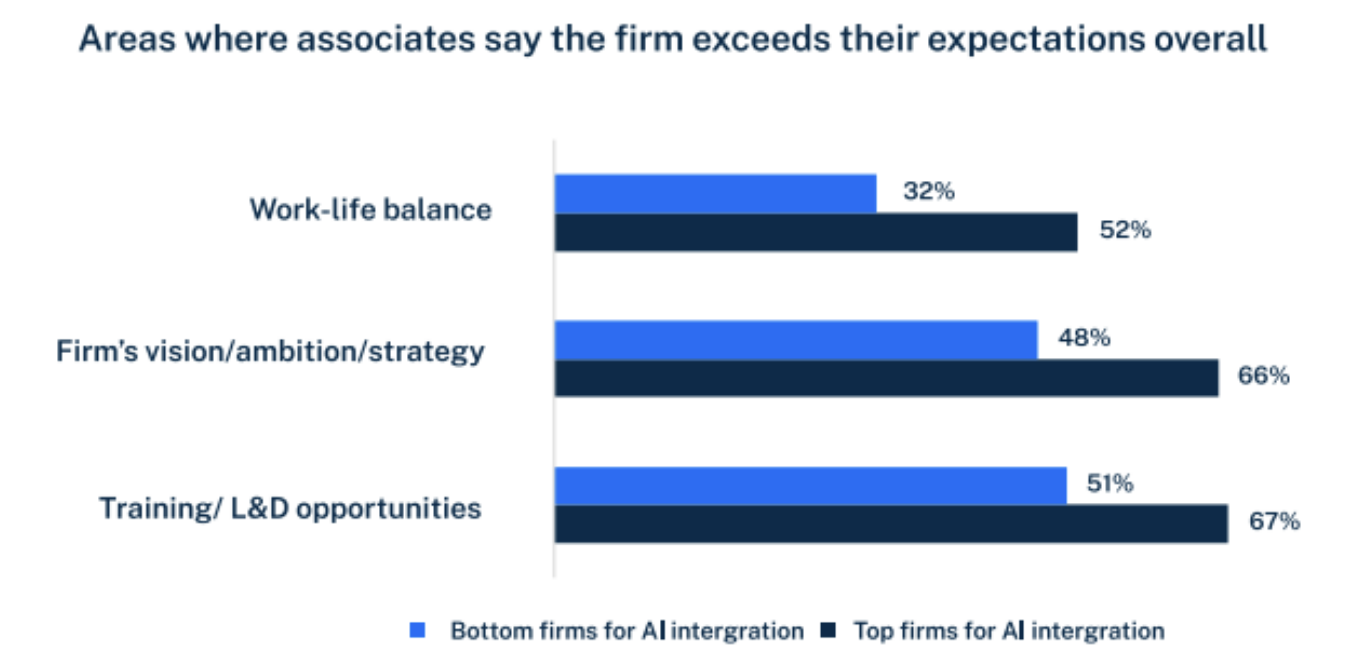
There are a multitude of possible reasons behind this, though the obvious conclusion is that a stronger AI direction at law firms means, on the ground, associates are benefiting from better workflows as a result of having to undertake less admin and grunt work, allowing more time for substantive tasks and stretch opportunities.
The key takeaway here is that for associates weighing a move, AI adoption is becoming an increasingly important consideration when it comes to job satisfaction and, ultimately, retention.
2. More attention than ever before is being paid to wellness and mental health among associates.
The conference kicked off with an opening session on ‘brain care basics,’ highlighting how front-of-mind the topic is for those in the industry. This reflects a broader shift in associate priorities as they consider career trajectories. Our most recent Chambers Talent research finds that, more and more, the next generation of associates entering the workforce are prioritizing mental wellbeing, and clearly, higher-ups are starting to pay attention.
A small number of BigLaw firms are now offering billable credit for hours spent on wellness and mindfulness activities, including exercise and meditation. However, aside from being a differentiator for those firms, the tangible effects of this have yet to be mapped out.
Alas, gone are the days when pay and prestige alone drove laterals to sign on the dotted line. The law firms who consistently top the charts for lateral desirability are those who deliver on culture promises and live up to initial expectations, indicating an increased expectation of transparency from both law firms and recruiters during the networking and recruitment process. On a related note, our research also found that law firms who failed to deliver on culture promises had the most flight risks with up to 60% of associates wanting to leave within the next two years.
3. Generational differences are finally being acknowledged and addressed.
The opening session for the second day of the conference was centered around ways law firms can increase productivity by better bridging generational differences within their teams as the next wave of associates enter the workforce. The conversation included a deep dive into the building blocks and cultural markers that drive motivation for each generation, whether that be Baby Boomers, Gen X, Millennials, or Gen Z.
The presentation suggested that, at a high level, younger associates (Gen Z) expect transparency, flexibility, and authentic communication. This includes transparency on expectations and where they stand in their careers. In turn, younger associates are more likely to be more open about the extent to which they are willing to sacrifice for a career.
Interestingly, predictions during the conference session indicated that Gen Z will have as many as three careers, which equates to approximately 15 to 20 jobs. If there’s anything to take from this, it’s that it’s a good time to be a recruiter!
4. Clarity and preparation matter more than ever when making a lateral move.
Beyond broader market trends, discussions also covered a range of practical insights around how associates should approach the lateral process itself.
First and foremost, simplicity is key when it comes to resumes. Some top tips include:
- Content must be skimmable! This means avoiding visual fatigue. Lawyers want things short, direct, and easily digestible.
- Avoid content overkill – or otherwise ‘the kitchen sink resume.’ Big no-nos are resumes that are several pages long, have large blocks of text, and endless bullet points. The rule of thumb is one page for junior candidates and two pages for those with more than ten years’ experience.
- Must includes are:
- your biggest areas of impact and the significance of your current role
- highlight your unique value
- organize experience into competency sections using short bullet points
- front-load your biggest achievements!
More broadly, associates were advised not to rely solely on referrals from a friend or ‘word on the street’ about a law firm’s reputation, but to build a well-rounded view of prospective firms by speaking to recruiters, current associates, or other informed sources. These conversations can give candidates a clearer picture of the true culture, workload, and opportunity at the firm.
What to watch in the year ahead
Several themes are clearly poised to continue shaping the lateral market, including the implications of AI adoption and implementation, wellbeing, and growing expectations of transparency. What remains important for associates is staying informed and being strategic about lateral moves. The conversations at the NALSC 2026 Annual Conference emphasized that, more than ever, the lateral market is becoming more nuanced and those in a position to benefit will be those who make thoughtful and informed plans.